ADAM IS WELL KNOWN FOR HIS TENACIOUS APPROACH TO CHALLENGING IMPAIRED DRIVING CHARGES AND HE HAS ENJOYED TREMENDOUS RESULTS FOR HIS CLIENTS.
Legal Experts Warn About Changes To The Impaired Driving Laws Of Canada That Could Give Far-Reaching Powers To The Police
Police could show up on your doorstep up to two hours after you arrive home in order to collect demand a breath or saliva sample if Canada’s new DUI laws are passed.Calgary defence lawyer Dale Fedorchuk says the proposed law “begs” to be challenged constitutionally and one of the things that concerns him most. Fedorchuk stated that if the law is passed, the officers would have the power to charge someone with impaired driving, even after they have parked their vehicle.The Trudeau government last month introduced sweeping changes that include mandatory roadside breath samples and much harsher penalties for some offences that could result in up to 10 years in prison among other measures.
If the Police have a reasonable suspicion that a driver has drugs in their body they can also demand a roadside saliva sample. The said changes were announced the same day the federal government unveiled its bill to legalize marijuana and are becoming the topic of debate among lawyers, legal experts and victim groups who are lining up to either praise or ban the legislation.Officers can simply demand a test and drivers will have no choice, since refusing to provide a sample is a Criminal Code offence. As per Section eight of the Canadian Charter of Rights and Freedoms “everyone has the right to be secure against unreasonable search or seizure.”
According to Fedorchuk, the proposed law could shift the burden of proof onto an accused. He said for example, that someone who is approached by police at their residence would have to prove they consumed alcohol or drugs at home after they exited their vehicle and were not driving drunk.Calgary police officers appear supportive of the new changes especially the section that drops the requirement that an officer must first have reasonable suspicion before demanding a breath test. Mothers Against Drunk Driving stated the proposed changes are a good first step.
Your Legal Liability if Your Guests Drive Home Drunk
You host a party where there’s food, music, cheering and alcohol. Then a guest, who has had a few drinks, gets into their car and drives home while under the influence. Are you liable to be held responsible if your guest or anyone else gets hurt in an accident? If you are having a party that includes alcohol, you should ensure that everyone who drinks gets home safe with the help of a driver, a cab or a room to lie in after the party is over. In case of bartenders and licensed establishments, there is a clear legal duty to cut out the alcohol if patrons seem intoxicated and to ensure they get home safely but for individuals who throw private parties, the law isn’t clear. However, the risk of legal liability exists and legal responsibilities may be broadening scope wise.
A case in Canada Childs v. Desormeaux, where a woman was paralyzed and her boyfriend killed in a car accident struck by the driver who had been drunk. The woman sued the hosts of a New Year’s party attended by the drunk driver who bought his own alcohol to the host’s home. According to personal injury lawyer Jeremy Diamond, the Supreme Court of Canada concluded that the social hosts do not owe a duty of care to third parties injured by intoxicated guests and added that the case did not determine whether there was a duty of care in other circumstances, such as foreseeability of harm is present for the guests themselves.
In order to reduce the risk of liability there are a few things hosts can do apart from providing accommodation and transportation such as not making drinks the focus of the party, cutting out alcohol well before time, take car keys away from the guests if necessary and avoid guests having serve themselves. Otherwise, with the inclination of the law to change itself according to the need of the hour it appears there would be a time when hosts will have to hire an impaired driving attorney for them in the near future.
Man From Des Plaines With 15 DUI Convictions Accused Of Driving On Revoked License In Hit And Run Crash
Christopher Clingingsmith, aged 52, has been charged with violating the terms of his bond in a pending DUI case as he was driving on a revoked license and possessed a fake ID in a hit and run crash, according to prosecutors. Clingingsmith is a Des Plaines man who has about 15 DUI convictions and a pending DUI case and was involved in a hit and run crash last weekend in Arlington Heights, Cook County on a revoked license. He had been free on a $400,000 bond on the DUI charge and the said bond was revoked at a hearing on Thursday, in Rolling Meadows branch court. Judge Steven Goebel, set bail at $1 million for charges related to the crash. According to the judge, Clingingsmith has the potential to be very dangerous as he has 15 prior DUI’s and was operating a two-ton motor vehicle.
Clingingsmith was involved in a hit and run crash and was arrested in Rolling Meadows after the crash took place early Saturday near White Oak Street and New Wilke Road in Arlington Heights. He faces up to 30 years in prison if he is convicted of the current DUI charge which is a Class X felony. He faced four previous prison sentences for DUI and other convictions according to authorities.
In the pending DUI against him, Clingingsmith was arrested by Arlington Heights police after he fled away from a hit and run crash in Des Plaines in June and crashed into another vehicle on Northwest Highway and Arlington Heights Road and was taken into custody thereafter, as per prosecutors. Clingingsmith’s next court hearing on the DUI case is April 25 in the Rolling Meadows branch court and it appears that no impaired driving defence will be helpful to him looking at all the previous convictions and pending case.
Things You Need to Know About Your Breath Test Sample if Stopped for a DUI
Stopped for suspicion of driving under the influence of alcohol and given a breath alcohol test? Well, here is all that you need to know:
According to lawyer Ziad Youssef of MyTrafficMan.net the Draeger 9510 is the breath alcohol instrument most commonly used in Washington DUI investigations and like the DataMaster, which is an obsolete instrument, it analyzes breath to help police estimate the level of alcohol in a person’s blood.
According to the prevalent laws in most of the states, the legal limit for breath alcohol has been set at .08, which means that anyone with a breath alcohol level of .08 is assumed to be driving under influence. However, recent developments in DUI defense strategies have created reasons to doubt the results of the instrument. The Draeger 9510 works with the help of software that has yet not been validated by the state. The said software controls the data when the breath alcohol sample is collected. It has sensors that check and record flow rate, volume, breath alcohol level and time to ensure the minimum criteria for a breath sample.
As per the DUI law in Washington, the instrument has to test only the last portion of air exhaled by the driver into the Draeger among other things. Challenging the reliability or accuracy of a Draeger 9510 breath test or its functioning have not resulted in the inadmissibility of the test results which means the hearings officer at a Department of Licensing hearing and the jury in a criminal trial will likely see results and they may consider the challenge in deciding what weight to give the test result. Presenting evidence of an invalid test is critical to successful hearing and may save the driver from DUI penalties since the burden of challenging the weight of a breath test is on the driver.
Judge Who Told Twin Cities Police Officer “I Am A Ramsey County Judge” Charged With DUI.
Ramsey County District Court Judge G. Tony Atwal was charged with DWI on January 2 as a St. Paul police officer asked him to get into the squad car on New Year’s Eve even though the man had told him “I am a Ramsey County Judge”. Patrick Cotter, who is Atwal’s attorney, stated that Atwal had made “regrettable statements to the arresting officer”. Atwal pleaded guilty to a gross misdemeanor in the afternoon on January 2nd, 2018. Atwal has been re-assigned to handle child protection cases and was earlier assigned Ramsey County District Court’s criminal division. Thomas Sipkins, executive director of the Minnesota Board of Judicial Standards said the board is “looking into the matter”.
Michael Brodkorb who is a blogger and a former state Republican political operative stated that he sought details in the case since he believed Atwal had received special treatment, being a judge. However, Cotter and Minneapolis City Attorney Susan Segal stated that Atwal received no special treatment while her office handled the case to avoid a conflict with their St. Paul counterparts.
Segal stated that Atwal wanted to resolve the case and had hired a defense attorney who reached out to the prosecutor. As per police reports the breath test of Atwal showed alcohol concentration of 0.17 which is way above the legal limit of 0.08 in Minnesota and faced an over 80 charge. Atwal had pleaded guilty to DWI, a gross misdemeanor and most of his sentence was stayed and he served 18 days on electronic home monitoring and received 2 years of supervised probation.
The Problem of Detecting and Proving DUI in Case of Marijuana
Using Cannabis for recreational purposes is legal now in California and since DUIC has always been a crime, recreational cannabis will increase the DUIC cases. As in the case of driving under the influence of alcohol where some people who are innocent get arrested based on the standard used by police while making an arrest. The problem of innocent people being wrongfully arrested of DUIC is greater than DUI-alcohol because cannabis is different. A century-old research of alcohol consumption and driving impairment, it is generally believed that everybody who has blood alcohol content above 0.08 percent is under the influence of alcohol for the purpose of driving.
The law enforcement evaluation tools currently in operation are not proper for evaluating DUIC. A 12 step Drug Recognition Evaluation sponsored by the International Association of Chiefs of Police is designed to assist an officer to decide whether a suspect has recent prior exposure to one of seven drugs including cannabis and is not designed to help evaluate whether a person is impaired for driving purposes.
Police officers are forced to make DUIC arrest decision based on the evaluation tools that are ill-suited and observations associated with cannabis use according to their training like inability in crossing one’s eyes, dry mouth, red and watery eyes or the odor of marijuana among others. Cannabis consumption has the potential to cause impaired driving just like prescription medication, but simply driving a vehicle after consumption of Cannabis is not DUIC. So, until and unless there are more sophisticated and advanced methods of investigation, people are going to get charged with a DUI of cannabis and there will be a lot of innocents getting arrested.
8 People Injured On Icy Reno Roads With 15-20 Cars Involved In Thursday Crash
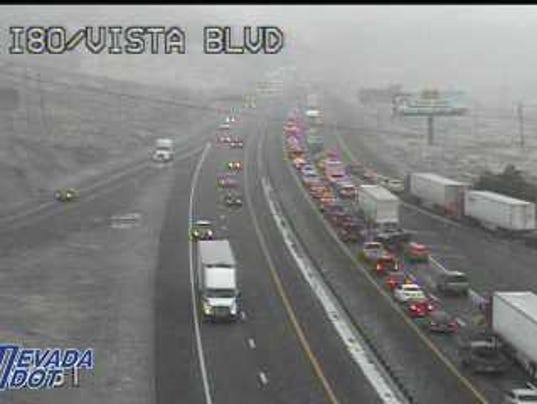
The Nevada Highway Patrol asked people to stay off the roads on Thursday evening after several multi-car crashes put the freeways in a shut-down state in the area. Officer Matt McLaughlin stated that around 15-20 cars piled up in a mid-afternoon shut down on the eastbound lanes of Interstate 80 east of Mustang. According to him the number of injuries was unclear, but McLaughlin stated that about eight people were transported by emergency response teams.
According to McLaughlin it was also virtually impossible to get from Carson City to Reno on Thursday afternoon, as northbound lanes on both Interstate 580 and Old U.S. 395 were closed. Another 15-20 car pileup triggered after a Nevada Highway Patrol Vehicle was struck and the I-580 closure was caused. McLaughlin stated that tow trucks and emergency response teams were working at “max capacity”.
In the northeast part of Nevada, the eastbound I-80 was closed for approximately four hours after two people were injured in a six-vehicle crash just before noon in the Carlin Tunnels west of Elko.NHP Trooper Jim Stewart stated that one victim suffered a possible broken leg but none of the injuries was considered life-threatening.However no one is reported to have been charged with a DUI or any other offence. In north-central Nevada, a record-breaking 3.6 inches of snowfall was reported in Winnemucca as it broke the old record of 2.9 inches set in 1919 according to the National Weather Service.
In the north of Reno, Stead, seven inches of snow had fallen.As per reports, the National Weather Service stated that 3.5 inches of snow was reported in three hours at Reno-Stead Airport and five inches was recorded in two hours in nearby Cold Springs during the Thursday morning commute. School was delayed two hours throughout Washoe County and five schools in Reno reportedly canceled classes. As per the forecast, up to 6 inches of snow was predicted into Thursday night at Lake Tahoe.
Police plan DUI enforcements on St. Paddy’s weekend
St. Patrick’s Day falls on a Saturday this year, which means many people will celebrate all weekend long.
Police will keep their Irish eyes peeled for impaired drivers.
If you drink green beer, be prepared to see red and blue lights in the review mirror. All weekend long, police will be cracking down on partygoers who choose to drive impaired.
According to a new study by the Centers for Disease Control and Prevention, binge drinking is a big issue for Americans — and not just on holidays.
In 2015, Americans drank more than 17 billion drinks annually; that’s 470 drinks per binge drinker. Half of the bingers are over the age of 35 and 80 percent are men.
State police want to remind people who plan to have one or two drinks that the consequences of buzzed driving are the same as drunk driving.
“With DUI enforcement, the purpose is to save lives,” Trooper Brent Miller said. “We have to take those drivers who are drinking or using illegal drugs [off the road] when they choose to get behind the wheel.”
There are many ways people can avoid needing to fight impaired driving charges. Police encourage anyone drinking to download the Safer Ride app, which can call a taxi or predetermined friend as well as share your location.
Police also encourage you to use transportation services such taxis, Uber and Lyft to party responsibly.
Illegal Immigrant Charged in DUI Crash That Killed Two Including Colts Player Edwin Jackson
In a latest case of drunken driving crash that killed linebacker of Indianapolis Colts, Edwin Jackson and an Uber driver, prosecutors filed felony charges against an immigrant living illegally in the U.S. who is said to have been deported twice before. Manuel Orrego-Savala, who hails from Guatemala, has been charged with two serious offences, causing death while driving intoxicated and leaving the scene of an accident. As per investigators Orrego-Savala has been living in the U.S. illegally for past several years and has reportedly been deported from the country twice in the year 2007 and 2009. After a blood test was conducted on Orrego-Savala, the hospital determined that he had a blood-alcohol level of 0.19 percent which is twice the permitted limit for driving in Indiana.
According to the investigators, Orrego-Savala had been living in the country without permission and was also charged with illegal entry of a previously deported alien and faces up to 10 years in prison on that charge alone. The U.S. Attorney’s office stated that the said charge would be handled after state charges are resolved.
The matter caught widespread attention as President Donald Trump took to twitter and termed the said accident as disgraceful and also nudged Democrats to collaborate with him on the issue of illegal immigration and security of the borders. However, Marion County Prosecutor Terry Curry while criticizing the comments stated that his office would prosecute the crash case that caused two fatalities in a vigorous manner regardless of the fact that Orrego-Savala was an illegal immigrant. On the other hand Jorge Torres who is dui defence lawyer for Orrego-Savala stated that his client is confused and highly distraught at the moment to say anything and further said that Orrego-Salava who is currently in jail, had been doing construction work in Indiana for several years and his immigration status does not have a bearing in the current case.
Drunk Canoeing Set to be Removed as an Impaired Driving Offence in Canada
The federal government may be gearing up to have stricter laws as far as drunken driving is concerned since marijuana has been legalized, it is also ready to let go of a law that put canoeists in trouble for having consumed a few drinks and then went on to canoe. Impaired driving charges attracted a lot of penalties such as automatic suspension of driving license, demerit points, steep fines, impounding of vehicle and installation of ignition unlocking devices. The police will no longer be able to impose such charges and will probably have to make do with other charges such as being intoxicated in public etc.
In the Ontario province the police is quite active and they patrol the area especially during the summers as the provincial government has stated that kayaks, canoes and inflatable rafts fall under the impaired driving laws. Charges were dropped in two cases where the defendants were in their canoes and were believed to have had a few drinks and the prosecutors decided that there wasn’t much in the cases to end up in conviction.
The criminal code currently stipulates that vehicles need to be motorized to be qualified under the impaired driving laws and also includes water-going “vessels” whether they are motorized or not. The term “vessels” has not been defined clearly and so leaves it open for the prosecutors and the police to decide its meaning. The definition of the term “vessels” is about to change as the vessel propelled by muscular power will not be included under the impaired driving laws. However, since the law is with regard to target those who endanger public, a person who causes harm to others while in a muscular powered “vessel” can still be charged.